
Posted on: November 1, 2026
How Much Deposit Do I Need for a Mortgage?
One of the first questions many homebuyers ask is: “How much deposit do I need for a mortgage?”
For many buyers, a 5% deposit is enough to access a mortgage, meaning you would borrow 95% of the property’s value.
However, there are now more options for buyers with smaller deposits. Some lenders offer mortgages at 98% or 99% loan-to-value (LTV), while a small number of products allow eligible buyers to borrow 100% of the property’s value.
There is also a new Government scheme for first-time buyers purchasing certain new-build homes, which is expected to allow purchases with a 2.5% deposit. Final details of this are still to be announced.
A larger deposit can still give you access to more mortgage deals and potentially lower interest rates, so the minimum deposit isn’t necessarily the amount you should aim for.
What is a mortgage deposit?
Your mortgage deposit is the amount you contribute towards the purchase of your home. The remainder is normally borrowed from a mortgage lender.
For example, if you were buying a £300,000 property with a 10% deposit:
Property price: £300,000
Deposit: £30,000
Mortgage: £270,000
This would be a 90% LTV mortgage.
The relationship between your deposit and LTV is:
5% deposit = 95% LTV
10% deposit = 90% LTV
15% deposit = 85% LTV
20% deposit = 80% LTV
2% deposit = 98% LTV
1% deposit = 99% LTV
Can I get a mortgage with a 5% deposit?
Yes. 95% LTV mortgages are widely available, meaning you could potentially buy a home with a 5% deposit.
For example:
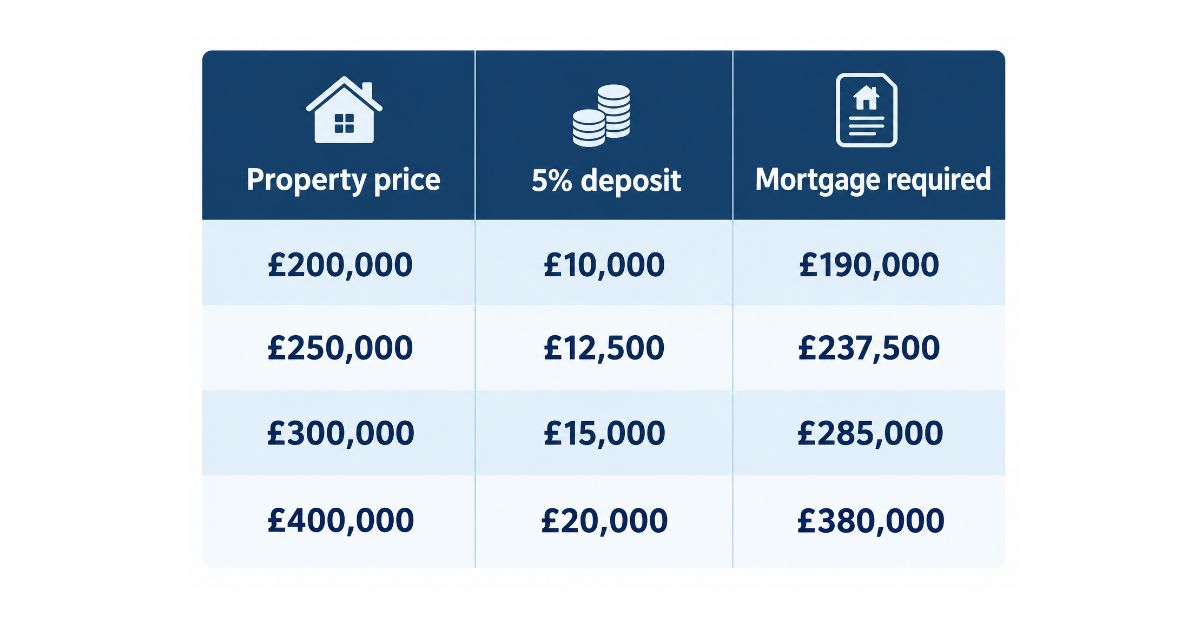
However, having a 5% deposit doesn’t guarantee that you’ll qualify. Lenders will also look at your income, expenditure, credit history, employment, existing debts and the property you’re buying.
Can I get a mortgage with less than 5%?
Yes. There are now some mortgages available with deposits below 5%.
Some lenders offer 98% LTV mortgages, potentially allowing a 2% deposit, while others have products with a minimum cash deposit of £5,000.
For example, Santander’s My First Mortgage allows eligible first-time buyers to borrow up to 98% LTV, while Yorkshire Building Society & Lloyds have a mortgage with a minimum £5,000 deposit and up to 99% LTV for eligible first-time buyers.
There are also 100% LTV mortgages available in certain circumstances, such as Skipton Building Society’s Track Record mortgage for eligible renters or with April mortgages.
These products have specific eligibility requirements and may have restrictions on the type or value of property you can buy.
New Government scheme could allow a 2.5% deposit on new builds
A new Government scheme called Your First Home has recently been announced for first-time buyers in England.
The scheme is expected to support eligible buyers purchasing a new-build property from a participating developer with a deposit of just 2.5%.
The Government says the scheme will be backed by a government equity loan of up to 20% of the property’s value. This means the buyer’s mortgage requirement could be substantially lower than it would be with a standard 95% mortgage.
For example, on a £350,000 new-build home:
- 2.5% deposit: £8,750
- Government equity loan: up to £70,000
- Mortgage: around £271,250
The equity loan is not a grant and will have to be repaid. The Government has said there will be an initial interest-free period.
The scheme is expected to include a household income cap and local property-price caps, while the property must be a qualifying new build from a developer signed up to the scheme. Developers will also be expected to contribute towards the cost of participating.
The Government has said further details, including the final eligibility criteria, costs and implementation timetable, will be announced at the October 2026 Budget.
It’s therefore important to distinguish Your First Home from a standard 97.5% LTV mortgage. The 2.5% deposit works alongside the Government equity loan rather than simply requiring a mortgage for the remaining 97.5%.
Is a bigger deposit better?
Not necessarily, but there can be significant advantages to having a larger deposit.
For a £300,000 property:
- 5% deposit: £15,000 deposit and £285,000 mortgage
- 10% deposit: £30,000 deposit and £270,000 mortgage
- 15% deposit: £45,000 deposit and £255,000 mortgage
- 20% deposit: £60,000 deposit and £240,000 mortgage
A larger deposit reduces the amount you need to borrow and your LTV. This can potentially give you access to more mortgage products and lower interest rates.
However, you don’t necessarily want to put every penny of your savings into your deposit. You’ll also need money for the costs of buying your home and ideally an emergency fund.
How much deposit should I aim for?
There isn’t one deposit percentage that is right for everyone.
A 5% deposit may be enough for many buyers, while those with less than 5% may now have other options.
If you can save 10%, 15% or 20%, you may have access to a wider range of mortgage deals and potentially lower rates.
The important thing is to look at the overall cost rather than simply focusing on the size of your deposit.
For example, if you have £10,000 saved:
- At 2%, it represents a £500,000 purchase price.
- At 2.5%, it represents a £400,000 purchase price.
- At 5%, it represents a £200,000 purchase price.
- At 10%, it represents a £100,000 purchase price.
These figures are purely mathematical examples. Whether you could actually borrow the required amount will depend on your income, affordability and the lender’s criteria.
Don’t forget the other costs of buying a home
Your deposit isn’t the only money you’ll need.
Depending on your circumstances, you may also need to budget for:
- Mortgage product or arrangement fees
- Solicitor or conveyancing costs
- Survey costs
- Stamp Duty Land Tax, where applicable
- Removal costs
- Buildings insurance
- Repairs and maintenance
- Furniture and other moving costs
- Mortgage broker or adviser fees, where applicable
This is why it can be risky to use all your savings for the deposit and have nothing left as an emergency fund.
Can my family help with my deposit?
Yes. Family members may be able to provide a gifted deposit, where money is given towards the purchase without being expected to be repaid.
Lenders have different requirements for gifted deposits and may ask for confirmation of where the money came from.
If you’re receiving help from family, tell your mortgage adviser and solicitor at an early stage.
What if I have a small deposit?
If you’ve saved less than 5%, don’t automatically assume that you can’t buy a home.
There are now mortgages aimed at buyers with 1%, 2% or 5% deposits, while the new Your First Home scheme could provide another option for eligible first-time buyers purchasing qualifying new-build homes with a 2.5% deposit.
However, low-deposit mortgages can come with higher interest rates or more restrictive lending criteria. It’s important to look at the monthly payment and total cost of the mortgage, not just the amount of deposit you need.
Ready to find out what you could borrow?
If you’re unsure how much deposit you need or whether you could qualify for a low-deposit mortgage, speaking to a mortgage adviser can help you understand your options.
Whether you have 2.5%, 5%, 10% or more, there may be different mortgage options available depending on your circumstances.
Get in touch today to discuss your mortgage options. Craig Power (craig.power@villagefs.co.uk) or Luke Spires (luke.spires@villagefs.co.uk) or you can call 0118 9410026.
Feel free to contact us if you have any questions.
Important information
Mortgage products, interest rates, eligibility criteria and Government schemes can change. The Your First Home scheme was announced in September 2026 and further details are expected to be confirmed at the October 2026 Budget.
The information in this article is for general information purposes and does not constitute financial advice.
Your home may be repossessed if you do not keep up payments on your mortgage.